Where 420 engineers and 380+ patents converge to redefine what enterprise networking can achieve — from AI-driven operations to 800GbE architectures.
Our machine learning platform ingests telemetry data from every port, every flow, and every device in real time. Anomaly detection algorithms identify patterns invisible to human operators, predicting failures 4-6 hours before they impact traffic and automating remediation through intent-based policies.
The result: a 73% reduction in mean-time-to-repair and 90% fewer manual configuration changes across production networks.

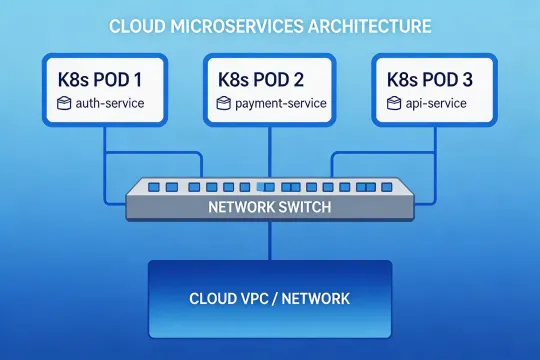
Built from the ground up as a containerized, microservices-based operating system, our network OS supports multi-tenancy, rolling upgrades, and programmable data planes through standard APIs. Full OpenConfig and gNMI support enables seamless integration with existing automation toolchains.
Run the same operating system across campus switches, data center spine/leaf, and edge routers — one OS, one CLI, one automation framework.
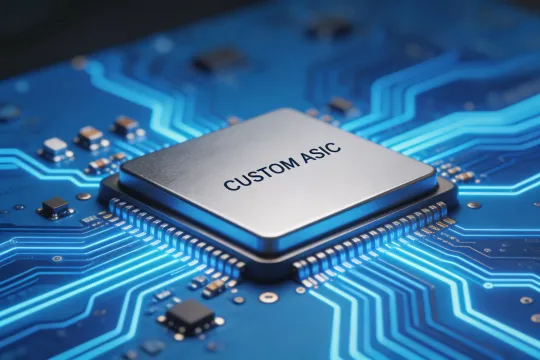
Our custom ASIC design team develops merchant-silicon-class forwarding engines with deep programmable buffers, advanced telemetry counters, and native encryption acceleration. The latest generation delivers 25.6 Tbps switching capacity with 40% lower power consumption per port compared to the previous generation.
Informed infrastructure decisions require understanding the engineering trade-offs behind each approach.
Organizations deploying campus and data center networks face a fundamental architectural decision: source all equipment from one vendor for integration simplicity, or adopt open networking standards (OpenConfig, SONiC) for flexibility.
Unified management plane, single point of support, proven interoperability, and faster initial deployment. Cisco, Juniper, and Nokia offer comprehensive single-vendor stacks with end-to-end support contracts.
Avoids vendor lock-in, enables best-of-breed component selection, and lowers hardware costs through white-box switches. Community-driven innovation through SONiC and OpenConfig accelerates feature development but requires stronger in-house engineering expertise.
Arista supports both models — our switches run natively on SONiC while also offering a fully integrated management platform. The right choice depends on your team's operational maturity and multi-vendor strategy.
The shift toward network function virtualization raises questions about whether to maintain physical core network equipment or migrate to cloud-native architectures.
Full control over data sovereignty, deterministic latency below 5 microseconds, and proven reliability for mission-critical voice and data. Required for environments with strict compliance mandates (FIPS 140-2, NEBS Level 3).
Elastic scaling, faster feature deployment cycles (weeks vs. quarters), reduced CAPEX through shared infrastructure, and alignment with DevOps practices. However, introduces dependency on cloud provider availability and variable latency profiles.
Many Arista customers adopt a hybrid model: on-premises hardware for latency-sensitive workloads (trading, real-time control) with cloud-native functions for management, analytics, and elastic services.
Key technical dimensions to evaluate when comparing enterprise networking platforms.
| Evaluation Dimension | What to Measure | Industry Benchmark |
|---|---|---|
| Switching Capacity | Total throughput in Tbps; line-rate forwarding at all port speeds | Top-of-rack: 6.4-12.8 Tbps; Spine: 25.6-51.2 Tbps (2026 market) |
| Forwarding Latency | Cut-through latency at 64-byte frames under load | Sub-1 μs for data center; sub-5 μs for campus with policy |
| Automation Maturity | API coverage (REST/gNMI/OpenConfig), streaming telemetry, intent-based policies | Full gNMI + OpenConfig support becoming table stakes; closed-loop AI varies widely |
| Power Efficiency | Watts per 100GbE port under typical load | 5-8W/100GbE port (current gen); 3-5W target for next-gen silicon |
| Software Licensing | Perpetual vs. subscription; feature tiers; OS upgrade policy | Industry shifting toward subscription; evaluate 5-year TCO including renewals |
Our forward-looking investment areas for the next three years.
Next-generation spine switches with 800GbE uplinks, supporting AI/ML training cluster interconnects with RDMA over converged Ethernet at scale.
Full closed-loop automation: AI systems detect, diagnose, and remediate network issues without human intervention for 95% of common failure modes.
Co-packaged optics and silicon photonics integration to eliminate transceiver modules, reducing power by 60% and enabling petabit-scale fabrics.
Every claim we make is testable. Here's how to verify our technology in your environment.
Request a 30-day PoC with loaner hardware configured for your topology. Our solutions engineers will set up the test environment and provide a standardized performance validation checklist covering throughput, latency, failover timing, and power draw measurements.
All performance claims reference testing conducted under RFC 2544 (throughput, latency, frame loss) and RFC 6349 (TCP throughput) methodologies. Test conditions: 25°C ambient, 100% port utilization, 64/512/1518-byte mixed frame sizes. Full test reports available under NDA.
We participate in Tolly Group and European Advanced Networking Test Center (EANTC) interoperability events. Results from the 2025 EANTC multi-vendor SDN interop test and Tolly switching performance benchmarks are available upon request.